
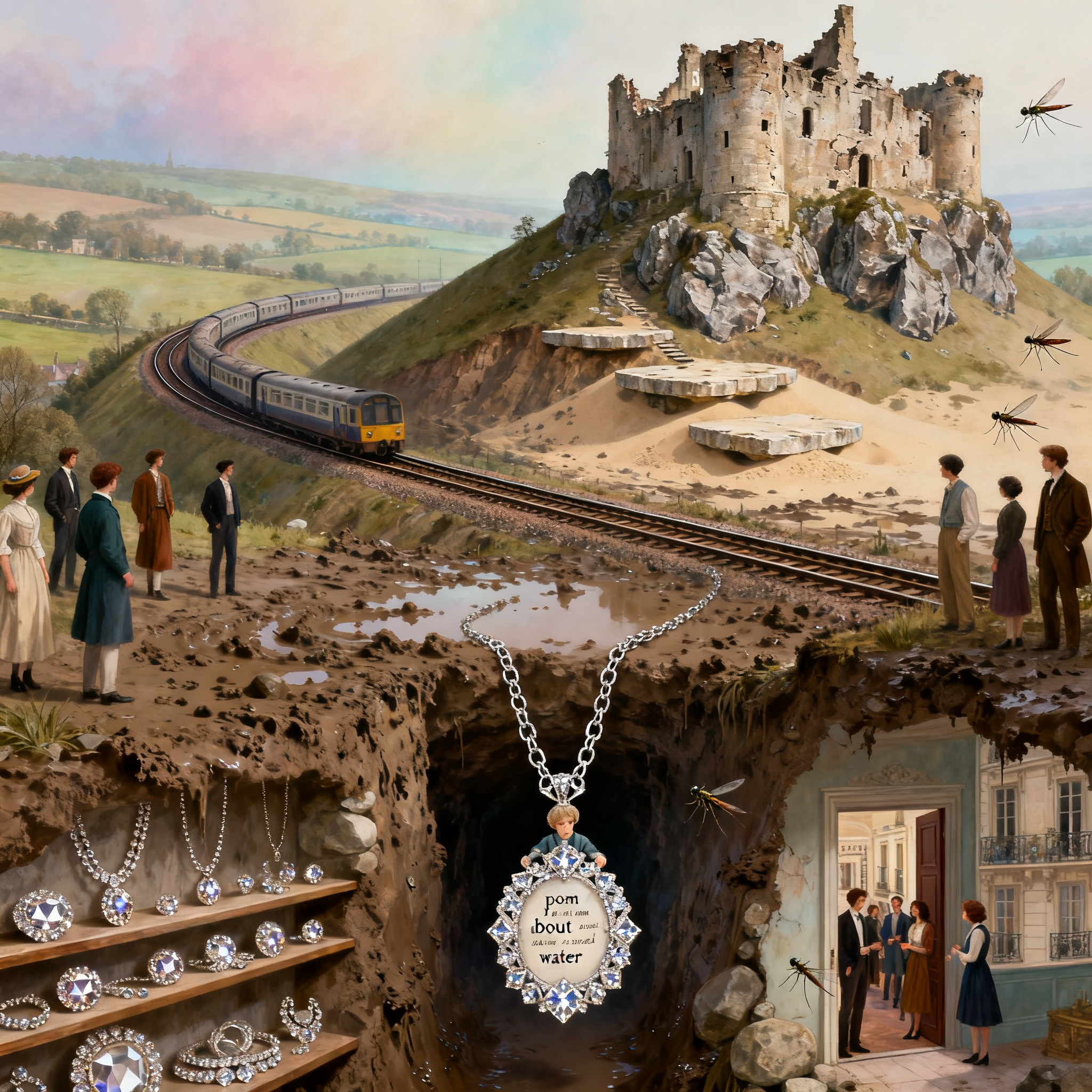
# The Descent Dream *Second recorded telling. Written in the present tense, as it happens.* --- I arrive on foot. The first thing is mud — a huge, open landscape, muddy and slippery underfoot. England, or somewhere in Europe, I'm fairly sure. Everyone around me looks Victorian, but I'm in modern clothes and it doesn't strike me as strange. Maybe it's the present day and this is simply how people dress here. Above me, along the top of the hill, there are proper modern train tracks: metal rails, the real thing. Lower down there are no rails at all — just grooves worn into the ground, carved by trains passing so often that the earth has given way. There's one on the left, but the line loops and crosses back over itself, so a train can come from the left and climb up onto the tracks, and another can come from the right, pass through the left side, and climb up too. I can't work out where any of them are coming from. I have to cross the terrain on foot, and I have to time it. There's no platform. Where people get off the train, the ground is simply flat. So I wait, and when the next lot of passengers step down, I cross with them — because then it's safe. Everybody is rushing. The whole space curves round like a circle, and somewhere in front of me the train always passes through. Ahead stands a large stone building, castle-like. It holds prisoners. It's a prison, or a mental health hospital, or both — I'm never certain which. People are encouraged to come and visit. The claim is that the prisoners have visibly improved, and it's because of the trains: they can move back and forth into society now. But that isn't the attraction. The attraction is that the building has levels, and you can climb down through them, and as you descend you pass through different parts of history. Things seem to be happening in front of me. Someone points and says: *that's where Shakespeare stole Sisyphus's story.* And I think, oh — okay. This time the whole structure is crumbling. It wasn't like this before. There are no stairs; you climb down on rock and on bits jutting out of the wall, and it is plainly at your own risk. I keep thinking that they must know it's safe, or they wouldn't let us in — but it doesn't look safe, and nobody is stopping anyone. On my right there are sandstone platforms where people have stopped. They aren't handling objects; they're interacting with the stories themselves, with whatever is happening there. The people on the platforms are solid. It looks fun, and I want to. But I'd have to jump across, and it doesn't look safe enough, and my favourite part is at the bottom. So I keep going. The bottom is the part I come for. Here the walls are solid — shelved, but solid, nothing crumbling. The shelves hold treasure, jewels and necklaces suspended somehow, all the way down a narrow passage. A chain goes round my waist. Not a metal chain — a decorative one, dripping with diamonds. It holds me and then lowers me, the way an aerial acrobat descends, and as I fall there's a poem being spoken and I follow along with it. Something about water. I spent so long memorising it. Each step down had its own little story or chant, and I knew them all. The rule, from the first time I came, is that I mustn't *take* anything. Looking is allowed; I can admire it, I can think *wow*. But I don't really look. I know it's beautiful without looking, and I don't want to take anything, and I don't want to be cursed. It is beautiful and free and unlike anything anywhere else. I land on my feet. There's a doorway right in front of me. I open it, and it's a Parisian apartment. Inside, someone is waiting. They ask whether I've been through it, and I say yes — I think this is my third time. I point at the necklaces around my neck and say I think this one is the only one I didn't get from here. Then I correct myself: maybe this is my second time. In the apartment I'm rewarded with a piece of jewellery. My friends are here. Susan is here, dressed beautifully. And there are mosquitoes, the way there were last time — one about to bite her, both of us batting at them. We aren't frightened. It's funny. It's just something to deal with. I wake up hitting my own arm, telling the mosquitoes to get off. --- *Last time the structure wasn't as crumbly. Last time there was an opera. Both times, my friends were already there.*
The dream of "The Descent" is a rich tapestry interwoven with themes of time, history, exploration, and a journey into the subconscious. Here's a detailed interpretation of the dream:
Arrival in a Victorian Landscape: This setting, with its Victorian characters, signifies a juxtaposition between the old and the new, reflecting the dreamer's engagement with tradition and modernity. Being in modern clothes while others sport period attire suggests a feeling of being out of sync or exploring how past influences intersect with current identity.
Train Tracks and Muddy Ground: The trains and tracks might symbolize life's journey or transitions. The absence of defined tracks lower down could represent uncertainty or unpredictability in life's path. The mud signifies challenges or emotional turmoil, a reminder that progress is often messy and requires careful footing.
Castle-like Building: This structure serves as a multi-level time capsule, a prison or mental health hospital, indicative of introspection and confronting inner demons or thoughts socially taboo or historically significant. The descent into its depths suggests a journey into one's subconscious, where memories and historical echoes live.
Interacting with History on Sandstone Platforms: Here, history becomes tangible, and those who stop to engage with the past do so actively, which could imply the dreamer's wish or guilt at not fully engaging with the past. It suggests a longing to understand or witness history, yet a hesitation to jump into it, fearing instability or insecurity.
Treasures and Poems at the Bottom: The bottom level, holding treasures and stories or poems of water, symbolizes reaching the subconscious's depths, uncovering hidden desires or truths kept shelved and secret. The rule of not taking anything warns against greed or alteration of one's core self. This part of the dream ties into spiritual or existential enlightenment - appreciating beauty and truth without altering it.
Parisian Apartment and Reward: Upon completing the journey, the dreamer finds themselves rewarded with a piece of jewelry in a Parisian apartment — a significant, conventional symbol of beauty and worth. This suggests self-acknowledgment, a reward for introspection, or societal acceptance after a personal journey. The apartment's cosmopolitan setting (Paris) imbues a sense of cultural richness and finality.
Friends and Mosquitoes: Friends, familiar and beloved, represent support and shared experiences. The mosquitoes could represent petty annoyances or distractions in life — nuisances made light through camaraderie and humor.
Crumbly Structure and Change Over Time: The crumbling nature of the building on this visit could denote the fragility of memory or the transient nature of mental states, as well as the dreamer's growth or changes over time. Remembering an opera from the past visit points to how one's cultural tastes resonate within the subconscious.
In summation, "The Descent" dream explores personal growth, historical impact, and the deep exploration of one's personal layers. It bridges the nature of tangible and intangible personal treasures, the support system of friendship, and the perseverance needed to navigate a journey through self-awareness and understanding.